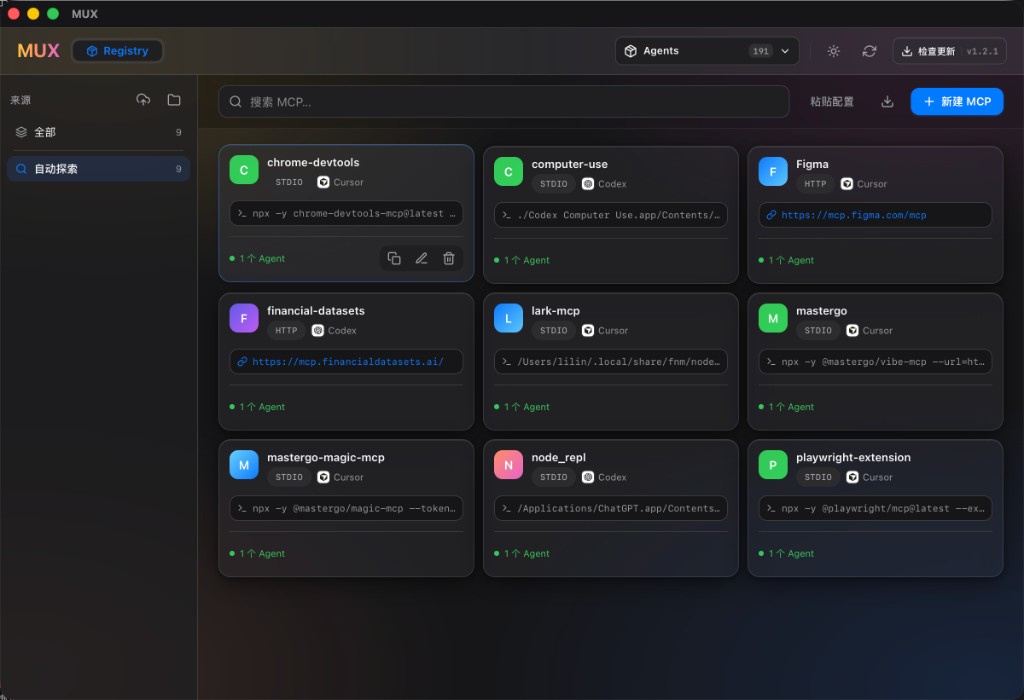
The desktop app is MUX's visual front-end (macOS, Tauri + React) for maintaining central MCP, Model, and Skill assets and letting Agents consume them. Data lives under shared ~/.mux/; the CLI can also query and change Agent consumption across all three domains.
Opening the app lands you on MCPs by default. The main interface is made up of these areas:
Area
Purpose
MCPs / Models (Beta) / Skills
Switch among the MCP catalog, model endpoints, and user-level Skills management.
Agent selector
Search audited Agent targets, including safe MCP writers and eligible Skills-only targets; discovery-only records remain available for catalog validation without appearing as a separate tab.
+
Add a custom agent, next to the agent selector.
Proxy / Theme / Rescan / Check for updates
Configure MUX networking, switch appearance, re-read each agent's config, and manually check for stable updates.
Source bar
Filter the catalog by source; the top offers "Add subscription" and "Import config."
Catalog toolbar
Search, view shadowed entries, paste config, export the effective config, create a new MCP.
MCP card grid
Shows name, transport, source, endpoint, usage, and conflict status.
The Registry shows every copy from all enabled sources by default. When the same name::transport appears in several sources, the higher-precedence copy takes effect and the rest keep showing rather than being hidden:
The effective copy keeps the normal card style, without a repeated "effective" label.
A shadowed copy uses an indigo accent, is marked shadowed, and notes "superseded by ."
A Shadowed N item appears to the right of the search box only when there's a conflict in the current scope; click it to see just the shadowed copies, click again to restore all.
Clicking a source on the left shows all copies from that source; the "shadowed" filter still applies only to the current source.
What's available for Agent consumption and export is the highest-precedence copy per composite key. For the full rules, see Precedence.
The normalized transport category; sse and streamable-http fall under the HTTP identity.
Source
An agent name, manual entry, local file, or subscription name.
Endpoint
The stdio launch command or HTTP URL, truncated when too long.
Usage status
A green dot means it's used by some agents; a gray dot means unused.
Cards select assets and show read-only consumer impact; lifecycle actions live in the Inspector. Within Desktop, Agent relationships are edited from the relevant Agent page. Only user-owned MCP source copies can be edited or deleted directly; subscriptions and imported files are managed by their source. External configurations observed only in Agent files are not Registry entries.
Confirm the Agent config file and MCP config file in the agent configuration center. They may be the same file or two separate files; MUX labels the relationship explicitly.
In MCPs, Model, or Skills, click Manage and set the Agent's complete desired selection from the central picker. MCPs and Skills allow multiple selections. Multi-model Agents may also receive multiple Model Profiles, with at most one current Profile at a time; single-model Agents still accept one. The MCP tab also offers Remove all MCPs. After explicit confirmation, it clears managed, disabled, and external MCP entries for that Agent without deleting central assets or changing other Agents.
Review relationship changes, target files, shared Skill targets, drift, and conflicts. MUX then backs up, writes in the Agent's native format, and rescans to verify the result.
Within Desktop, consumption relationships are edited from Agent pages; central asset Inspectors do not configure Agents. The CLI manages the same relationships through the shared assign / unassign / enable / disable verbs. MUX currently manages only user-level global configuration.
An Agent page shows desired central assets even if an observed target is missing or ambiguous. Core projects each relationship as synced, externally added, changed, removed, unparseable, ambiguous, or unsupported; it never silently overwrites external changes. Removing use changes that Agent's relationship and managed target but does not delete the central asset.
Configurations found only in Agent files first appear as read-only external state; scanning never silently imports them. Each observation exposes only safe core-projected convergence actions. Deleting a central asset first reviews all consumers, then atomically removes every managed target and relationship together with the central record.
Edit: modify a user-owned central entry. The plan retains relationships and includes every consumer, then commits the central asset and all targets together.
External-state convergence: manually customized targets expose adopt, restore, or detach in place. The operation binds the current inventory revision; conflicts or concurrent changes block that operation without locking unrelated domains.
Paste config: supports recognizable JSON, TOML, or YAML; once parsed it's added to "manual."
Export the effective config: the download icon in the toolbar exports the full, deduplicated catalog — not just manual entries; the CLI equivalent is mux mcp export.
The top of the source bar has just two add actions:
Add subscription: enter a remote config URL; the Mux curated button in the dialog fills in the official curated subscription.
Import config: select a local JSON / TOML config file.
Remote subscriptions and local files can be refreshed; unmanaged sources can be deleted. Rescanning Agents only refreshes observed inventory and never creates managed discovered entries in the background. Historical state enters a private central source only after migration confirmation. Source removal deletes its cache and catalog copies, while existing desired relationships must be handled through an impact plan.
The source model itself supports enable/disable, which the TUI's "Sources" screen does with Space / Enter. The desktop v1.2.0 source bar does not yet offer an on/off toggle.
The + to the right of the top agent selector adds a custom JSON, TOML, or YAML agent.
An Agent page is that Agent's consumption center. MCPs, Model, and Skills tabs show only desired central assets, their reconciled status, configuration paths, and a central picker; they do not embed asset creation, source resolution, or Skill installation.
When the paths match the page shows “Same file”; when model settings and MCP use different files it shows “Separate MCP file.” Paths identify configuration targets only; MUX never returns the complete config to the UI.
Inside a built-in agent's page you may override the global MCP path and section key; the official format, layout, and codec remain catalog-owned, to avoid producing incompatible configs.
Paths inside the home directory are saved as ~/…; absolute paths outside it keep their original value.
MUX currently has 57 audited Agent definitions, 47 writable MCP targets, 45 Skills targets, and 17 Model targets (13 managed and 4 guided). Its 201 discovery-catalog entries combine with the audited definitions into 212 unique identities. See Supported agents for the full matrix.
The top-level Models workspace creates central reusable Profiles without touching an Agent. Each Agent page then shows assigned, enabled, and current state. A native multi-model Agent may retain several Profiles but has at most one current Profile; a single-model Agent remains limited to one. Editing propagates through every consumer and deletion cascades through relationships and managed targets. The central API-key copy remains in macOS Keychain and never enters settings, persisted plans, previews, or backups. Claude Desktop is the reviewed direct-connect exception: applying a Model exports the selected key into its dedicated private 0600 MUX Profile.
Claude Desktop and Claude Code currently accept Anthropic Messages profiles, Codex uses the Responses API, and Grok Build plus Pi support all three initial protocols. Claude Desktop creates one reviewed MUX-owned direct Profile and disables its model-name verification for non-Claude routes. Grok Build reads authentication through its documented env_key; MUX never writes a Keychain secret into TOML. Qoder and MiniMax Code remain guided setup targets.
The top-level Skills workspace downloads from public GitHub or directly imports a local folder or Skill archive into one central copy, without an installation review screen. A separate consumer operation from an Agent page links that copy into verified Agent directories. Agents sharing one physical target are selected as an inseparable group; Agent pages never resolve or install a Skill source.
Skills do not require system Git, Node.js, or npx. This version does not support project-level content or private repositories. The CLI provides skill list/show/status/assign/unassign/enable/disable/converge; the no-argument TUI remains MCP-focused. See User-level Skills for installation, shared aliases, backups, and recovery.
The network icon in the top bar configures one global proxy for MUX. It accepts http://, socks4://, socks4a://, and socks5:// addresses. Later GitHub Skill, remote-source, CLI update, and Desktop update requests use the saved proxy; save an empty value to turn it off. HTTPS proxy endpoints, socks5h://, and proxy credentials are not supported, keeping usernames and passwords out of ~/.mux/settings.json.
About 2.5 seconds after launch, the app silently checks for the latest stable release; a failure won't interrupt you.
Check for updates vX.Y.Z at the top lets you check manually anytime, and shows the error on failure.
The download runs in the background; once done you can restart immediately or have it take effect on the next launch.
The stable app bundles the CLI and maintains the ~/.local/bin/mux symlink after launch. See Installation.
Before modifying an existing agent config, the original is backed up independently to ~/.mux/backups/; if the backup fails, that target is stopped.
Atomic replacement and concurrent-modification checks avoid half-written files or overwriting changes the agent made at the same time.
When adding or removing a target server, only the MCP node is modified — the complete agent config is never read into the UI or returned.
When updating an existing server, only managed connection fields change, preserving its permissions, OAuth, tool policies, and other specific fields.
If a ChatMCP file contains OAuth, token, or client-secret material, MUX refuses the entire write before backup; sensitive entries never enter MUX inventory or backups.
Other top-level keys, other servers, comments, indentation, and key order are preserved; writes are refused when the JSON, TOML, or YAML structure is invalid or ambiguous.
~/.mux/settings.json uses atomic writes via temp file plus rename.
The command line queries and manages Agent consumption for MCPs, Models, and Skills; the no-argument TUI focuses on MCP compatibility management → CLI / TUI.